At Zetland Primary we understand the importance of promoting and maintaining emotional wellbeing for children in our care, their families and the team of adults around them at school. As a result, we have created our own policy focused on ‘Improving Emotional Wellbeing and Emotional Literacy Using the 5 Point Scale’. This document can be found here.
5-point-scale
Image 1 of 1
The 5 Point Scale
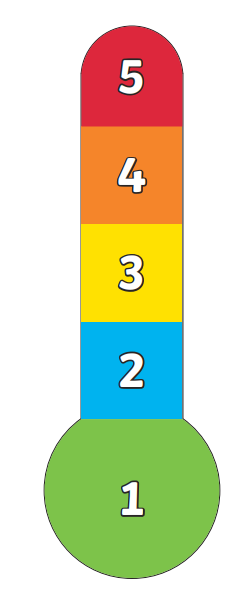
At Zetland, we use the 5 point scale to help each other share how we are feeling and to show when we need support. It can be very difficult to find the words to express how we feel when we need some help, especially if we are upset, angry or not sure of how to describe what we are thinking. It can also be challenging when adults try to help in different ways, using different words and trying to talk before we are ready. The 5 point scale helps to simplify this and is used through school from our youngest children in nursery, up to Year 6 and everywhere in between. The scale is visible on staff lanyards and around school and can be referred to whenever needed, children recognise that if they are feeling a 3, 4 or 5 they will need to take action to help themselves to feel more settled and ready to learn. We need children to understand that each scale point number is important at the right time but if we spend too long at the wrong point we won’t feel our best. We also want children to recognise that everyone, children and adults, will find themselves at all of these points at some time or another, everyone has emotional wellbeing.
The table below gives an example of the different scale points.
Scale Point
What might this look like?
1
Relaxed, calm, resting, settled, chilled, quiet (Perfect for down-time)
2
Ready to learn, listening, engaging, participating, busy (Perfect for school)
3
Excited, frustrated, bouncy, losing focus, loud, chatty (Time to make a change either independently or with help)
4
Teary, upset, refusing, shouting, distracted, disengaged (Adult help needed to get back on track)
5
Aggressive, unsafe, unable to listen, crying, screaming (Adult help needed to calm)
Wellbeing Toolkits
When we notice that someone is looking like a ‘3, 4 or 5’ we would suggest they use the Wellbeing Toolkit. These toolkits are located in every classroom and communal area of school. These toolkits consist of a box containing five carefully selected activities and equipment to help regulate the emotions and to help the user move down the scale. The activities and equipment are based on five principles known to encourage mindfulness, to increase focus and to help improve wellbeing. Below are some examples.
To feel better I can…
Wellbeing Toolkit Contents
Breathe
Breathing exercise cards or bubbles
Move
Theraband, movement cards
Touch
fidget toys, brushes, Lyrca fabric
Create
play dough, Lego
Distract
colouring, word searches, puzzle
Emotional Wellbeing at Home
If you feel that your child is finding it difficult to regulate their emotions at home, then it may be helpful to try out the 5 Point Scale and Wellbeing Toolkit too – children will already be familiar with the language and principles used from seeing it at school. If you require any further support with this then please discuss with your class teacher or Mrs Herd (SENDCo).
In school we support both children’s physical and emotional wellbeing. Please speak to a member of staff if you have any worries or concerns. Here are some suggestions of websites to look at for more support as well.
This service provides support to young people and their families. The team delivers person centered therapies to meet a range of needs. For further information please contact school, or check out the link to see what InsideOut can offer.
This website uses cookies, or tiny pieces of information stored on your computer, to verify who you are when you are logged in to the administration area.
Types of cookies we use
We use the following types of cookies:
strictly necessary cookies – these are essential in to enable you to move around the websites and use their features. Without these cookies the services you have asked for, such as registering for an account, cannot be provided.
functionality cookies – these cookies allow the website to remember choices you make and provide more personal features. For instance, a functional cookie can be used to remember the volume level you prefer to use when watching videos on our websites. The information these cookies collect may be anonymised and they cannot track your browsing activity on other websites.
First Party Cookies
Provider
Cookie name
Purpose
Further information
Website
ir_test
This tests whether the device is suppressing cookies
Website
cke
This cookie is used to remember whether you wish to view the cookie notice or not.
Google Analytics
_ga _gat_gat_oxRollUpTracker_gat_UA-*****
These cookies are used to collect information about how visitors use our site. We use the information to compile reports and to help us improve the website. The cookies collect information in an anonymous form, including the number of visitors to the website, where visitors have come to the site from and the pages they visited.
Cookies are used by WooCommerce in a variety of ways.
Cookies depend on specific features that are enabled on a store. The cookies are active when a user interacts with one of these features or to allow admin functions to be performed from within the store’s dashboard (/wp-admin).
Details are provided in tables below, listing various cookies that are set for users of stores with the WooCommerce plugin installed.
Stores a randomly-generated anonymous ID. This is only used within the dashboard (/wp-admin) area and is used for usage tracking, if enabled.
Web Application Firewall Cookies
To help you understand which cookies the Wordfence plugin sets, when installed on your WordPress site, we have provided the guide below. Wordfence currently sets three cookies and we explain what each cookie does, who will have the cookie set, and why the cookie helps secure your site.
wfwaf-authcookie-(hash)
What it does: This cookie is used by the Wordfence firewall to perform a capability check of the current user before WordPress has been loaded.
Who gets this cookie: This is only set for users that are able to log into WordPress.
How this cookie helps: This cookie allows the Wordfence firewall to detect logged in users and allow them increased access. It also allows Wordfence to detect non-logged in users and restrict their access to secure areas. The cookie also lets the firewall know what level of access a visitor has to help the firewall make smart decisions about who to allow and who to block.
wf_loginalerted_(hash)
What it does: This cookie is used to notify the Wordfence admin when an administrator logs in from a new device or location.
Who gets this cookie: This is only set for administrators.
How this cookie helps: This cookie helps site owners know whether there has been an admin login from a new device or location.
wfCBLBypass
What it does: Wordfence offers a feature for a site visitor to bypass country blocking by accessing a hidden URL. This cookie helps track who should be allowed to bypass country blocking.
Who gets this cookie: When a hidden URL defined by the site admin is visited, this cookie is set to verify the user can access the site from a country restricted through country blocking. This will be set for anyone who knows the URL that allows bypass of standard country blocking. This cookie is not set for anyone who does not know the hidden URL to bypass country blocking.
How this cookie helps: This cookie gives site owners a way to allow certain users from blocked countries, even though their country has been blocked.
Third Party Cookies
To enrich our website content, sometimes we may embed video content from other social media websites such as YouTube or Facebook. As a result, when you visit a page with content embedded, you may be presented with cookies from these websites. This website has no control or liability over these cookies set, so you should check the relevant third party’s cookie policy for more information.
We also offer a ‘share page’ widget on some of our web pages, where content can be shared easily on the following sites – Facebook, Twitter, MySpace, Delicious and Digg. These sites may set a cookie when you are logged into their service. This website has no control or liability over these cookies set, so you should check the relevant third party’s cookie policy for more information.
Some links and resources are provided below to assist your understanding of the types of cookies you may encounter.
Provider
Cookie name
Purpose
Further information
Google maps
NID PREF khcookie
These cookies are used by Google to track how many people are using their maps
YouTube may still set cookies on the user’s computer once the visitor clicks on the YouTube video player, but YouTube will not store personally-identifiable cookie information for playbacks of embedded videos using the privacy-enhanced mode.
This website will not use cookies to collect personally identifiable information about you. However, should you choose to disable, reject or block our cookies, some parts of our website will not function fully, or in some cases, our website will not be accessible at all.
Most web browsers allow some control of most cookies through the browser settings. To find out more about cookies, including how to see what cookies have been set and how to manage and delete them please visit http://www.allaboutcookies.org/.
Any changes we may make to our Cookie Statement in the future will be posted on this page.
Last Updated: 12/02/21
Privacy Policy
We regard your privacy as important and any personal information you give to us will be used in accordance with the Data Protection Act and the General Data Protection Regulations.
We do not store personal information about individuals who visit this site except where they provide contact information via our contact us page and contact forms available on various pages throughout the website.
Any information you provide will only be used for the reasons specified and it will not be shared with any third party without your consent, unless required by law.
Your contact details are kept securely and are only accessed by authorised members of staff as part of the provision of school services. If you do not wish us to keep this contact information please tell us.
This website uses Google Analytics which provides statistical data about the usage of the site. This information is not used to identify individuals, but is collected to provide us with an understanding of the areas of interest on our site and how our site is being used.
If you are connected to the internet you will have an IP Address. This may take the form of a figure, such as 333.333.22.1. The address will be automatically collected and logged as part of the connection of your computer to our web server and may be used to determine the total number of visits to each part of the site. This data is not collected and used for other purposes.
This website contains links to other websites. The School is not responsible for the privacy practices of other sites or organisations and recommends you consult the privacy information on those sites.
This policy will be reviewed and updated versions will be posted on the website.
If you have any questions about the use of your personal information, the Information Commissioner is the independent regulator for both Data Protection and Freedom of Information.